
 |
Energy Independence |
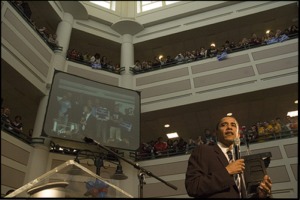
TOPIC: Oil & Alternative Fuels September 20, 2006 Energy Independence: A Call for Leadership Complete Text Now that summer's over and gas prices have finally come down a bit, there's a temptation to put any discussion about energy on the back burner until the next crisis arises. Gone are the days when the President would make sweeping pronouncements in his State of the Union about America's addiction to oil - today there is far more political mileage out of questioning Democrats' commitment to fighting terror than by affirming America's commitment to energy independence. But as the President may or may not have learned by now, simply ignoring a problem doesn't make it go away. Because while headlines about price gouging and gas lines have temporarily faded from the news, new headlines have emerged that should have us every bit as concerned about the addiction we just can't seem to shake. In just the last week, two in particular caught my eye. One is from the Detroit Free Press, and it talks about how Ford Motor Company plans to cut 30,000 hourly jobs, 14,000 salaried jobs, and close sixteen plants by 2012. Now, there are plenty of reasons for Ford's financial troubles, but one of the most glaring has been their inability to compete with foreign counterparts by transitioning to the fuel-efficient and hybrid vehicles that represent the future of the auto industry. 200,000 of these hybrids are driving around China today, a country that already has a higher fuel economy than we do. Over in Japan, Toyota is doubling production of the popular Prius to sell 100,000 in the U.S. this year. But at Ford, there are plans to make only 20,000 Escape Hybrids in 2006, and GM's brand won't be on the market until 2007. Meanwhile, the waiting lists for a hybrid car in this country get longer by the day. These foreign auto companies are out-innovating and out-competing us, and if we do nothing to help U.S. carmakers, tens of thousands more jobs and billions in business will be heading overseas in the months to come. Unfortunately, job losses and foreign competition are just the half of it. Because the second headline that caught my eye was in Saturday's New York Times, and it read, "Suicide Attacks Foiled at 2 Oil Sites in Yemen." This news is disturbing, but not surprising. For years, Al Qaeda has been trying to attack Middle Eastern oil refineries as a way to wreak havoc on the U.S. economy. Osama bin Laden himself has said, "Focus your operations on oil, especially in Iraq and the Gulf area, since this will cause them to die off [on their own]." In the past, even minor attacks have caused global prices to jump $2 per barrel in a single day. And a former CIA agent tells us that if terrorists ever succeeded in destroying an entire oil complex, it could take enough oil off the market to cause financial catastrophe in America. More than anything else, headlines like these represent a realization that goes far beyond the temporary rise and fall of gas prices. It's a realization that for all of our economic dominance - for all of our military might - the Achilles heel of the most powerful country on Earth is the oil we cannot live without. The President knows this. That thousands of autoworkers are losing their jobs. That we spend $18 million on foreign oil ever hour. That our climate is changing and global temperatures are rising. And yet, for someone who talks tough about defending America, actually solving our energy crisis seems to factor pretty low on the President's agenda. And that's because as much as George Bush might want to defend America, he also needs to defend his vision of government - and that's a government that can't, won't, and shouldn't solve great national challenges like our energy dependence. That's why the President's funding for renewable fuels is at the same level it was the day he took office. That's why his budget funds less then half of the energy bill he himself signed into law. That's why billions of tax dollars that could've been used to fund energy research went to the record-profiting oil companies instead. And that's why it's time to stand up for a new vision of government this November. You see, it's this timidity - this smallness - in our politics that's holding us back right now. The idea that some problems are just too big to handle, and if you just ignore them, sooner or later, they'll go away. But that's not where the American people are. They still believe in an America where anything's possible - they just don't think their leaders do. They still dream big dreams - they just sense their leaders have forgotten how. There's a reason that some have compared the quest for energy independence to the Manhattan Project or the Apollo moon landing. Like those historic efforts, moving away from an oil economy is a major challenge that will require a sustained national commitment. During World War II, we had an entire country working around the clock to produce enough planes and tanks to beat the Axis powers. In the middle of the Cold War, we built a national highway system so we had a quick way to transport military equipment across the country. When we wanted to beat the Russians into space, we poured millions into a national education initiative that graduated thousands of new scientists and engineers. If we hope to strengthen our security and create hundreds of thousands of new jobs, we can offer no less of a commitment to energy independence. With technology we have on the shelves right now and fuels we can grow right here in America, by 2025 we can reduce our oil imports by over 7.5. million barrels per day - an amount greater than all the oil we are expected to import from the entire Middle East. We start by producing cars that use less oil. The auto industry has not been asked to raise fuel economy standards in seventeen years, and lately we've just stopped asking them to. Today, we have no choice. Starting in 2008, if we raised CAF'E standards a modest 3% a year over the next twelve years, by 2020 passenger vehicles would average 40.5 mpg and light trucks would average 32.6 mpg. This is by no means a dramatic increase - five years ago, the National Academy of Sciences concluded that raising CAF'E to 33 mpg for passenger cars could easily be done without compromising passenger safety. Not only would this reduce America's oil consumption, but it would increase profits for the auto industry. Yesterday a University of Michigan report came out that said if the Big Three automakers took proactive steps to increase the fuel-efficiency of their vehicles, they would stand to gain up to $2 billion more in profits per year. But if they continue on their current path, they could stand to lose up to $3.6 billion in profits. Of course, auto executives are right when they say that transitioning to these more fuel-efficient automobiles would be costly at a time of sagging profits and stiff competition, and that's precisely why the federal government shouldn't let the industry face these costs on their own. We should strike a grand bargain with the Big Three automakers where the government picks up part of the tab for their retiree health care costs - a tab that ran almost $6.7 billion just last year - in exchange for the car companies using that savings to invest in more fuel-efficient cars. Beyond raising CAFE, however, it's time we replace oil altogether as America's fuel of choice. This doesn't just mean singing the praises of ethanol and hoping that it finds its way into our fuel supply on its own. It means taking major steps now to put a national biofuel infrastructure in place. Already, some cars on the road have the flexible-fuel tanks necessary for them to run on E85, a cheaper, cleaner blend of 85% ethanol and 15% gasoline. But millions upon millions of cars still don't have these tanks. It's time for them to install those tanks in every single car they make, and it's time for the government to cover this small cost, which currently runs at just $100 per car. We should also make sure that from now on, every single automobile the government purchases is a flex-fuel vehicle. It's also a time to start making E85 fueling stations more available to the public. Currently, only 681 out of 170,000 fueling stations in America offer E85 pumps. This is not acceptable. Every American should have the choice to fill up their car with E85 at any fueling station. And oil companies should stop standing in the way and join us in making this happen. If the big oil companies would devote just 1% of their first quarter profits this year to install E85 pumps, more than 7,000 service stations would be able to serve E85 to hungry motorists. Finally, we should reduce the risk of investing in renewable fuels by providing loan guarantees and venture capital to those entrepreneurs with the best plans to develop and sell biofuels. And we should create a market for renewable fuels by ramping up the renewable fuel standard and creating an alternative diesel standard in this country that together would blend 65 billion gallons of renewable fuels into the petroleum supply each year. In the days and months after September 11th, Americans were waiting to be called to something bigger than themselves. Just like their parents and grandparents of the Greatest Generation, they were willing to serve and defend their country - not only on the fields of war, but on the homefront too. This is our chance to step up and serve. For decades, we have heard President after President call for energy independence in this country, but for decades, we have fallen short. Well it's time to call on ourselves. We shouldn't wait for the next time gas hits $3 a gallon - and we shouldn't accept any more headlines that talk about a dying auto industry or a terrorist plot to use oil as a weapon against America. We should act - and we should act now. Now is the time for serious
leadership to get us started down the path of energy independence.
Now is the time for this call to arms. I hope some of the ideas
I've laid out today can serve as a basis for this call, but I also
hope that members of both parties and all levels of government can
come together in the near future to launch this serious quest for
energy independence. Thank you. |
|

| |

You can only imagine how many different ways people type the name Barack Obama. Here is a sampling for his first name: Barac, Barach, Baracks, Barak, Baraka, Barrack, Barrak, Berack, Borack, Borak, Brack, Brach, Brock even, Rocco. There are just as many for his last name: Abama, Bama, Bamma, Obma, Obamas, Obamma, Obana, Obamo, Obbama, Oboma, Obomba, Obombma, Obomha, Oblama, Omaba, Oblamma and (ready for this?) Ohama. And of course there's Barack Obama's middle name, Hussein. Here are some of the ways it comes out: Hissein, Hussain, Husein, Hussin, Hussane and Hussien.