
 |
Immigration Rallies and Status of Reform - Podcast Transcript |
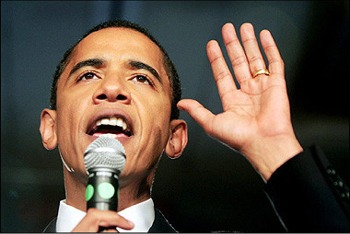
TOPIC: Immigration May 4, 2006 Immigration Rallies Complete Transcript Hello, this is Senator Barack Obama and today is Thursday, May 4th, 2006. On Monday, I traveled from D.C. to Chicago to witness a monumental event. There were 400,000 people marching on behalf of comprehensive immigration reform in this country. There were rallies all across the country but Chicago was one of the largest. I had the opportunity to speak to the people who were gathering at Union Park before they marched over to Grant Park. Four-hundred thousand people, mostly of Mexican origin, but large numbers of people from other countries - Nigerians and Pakistanis and Indians and Filipinos - people who've come to this country for the same reason that immigrants have been drawn to this country for generations: the notion that they can pursue and better life for themselves but, most importantly, for their children, if they work hard and apply themselves. I think most of you are familiar with the issues that have surrounded immigration. They've gotten a lot of attention recently. We have a system of legal immigration in which people are drawn through the normal processes and they apply for legal residency and ultimately get naturalized as citizens if they so choose. The controversy right now surrounds undocumented workers - people who came here illegally, most of them crossing the border between Mexico and the United States. It's estimated at this point that we probably have 11 to 12 million undocumented workers around the country. Most of them are employed in low-wage backbreaking work in agricultural sectors, in packing plants, in restaurants, in construction. Obviously, the country feels ambivalent about this influx. On the one hand, I think many of us (including myself) believe that these people are doing what any of us would do if we had an opportunity for a better life for our kids. They take the risk of coming here; many of them are extraordinarily impoverished and would not likely be able to get to the United States through the limited number of visas that are currently issued. On the other hand, we are a nation of laws and these people did come here outside of the law. Economists debate what kind of effect undocumented workers have in this country. There's no doubt that in many areas, like the agricultural sector, these immigrants are doing work that Americans would not do, at least at the wages that are paid. There are other circumstances in which it is clear that employers are importing these workers simply because they don't want to pay the living wages that Americans demand. There is no doubt that if construction companies were willing to pay more that they would see more U.S. workers applying for those jobs. It does appear that undocumented workers have a somewhat adverse effect in depressing the wages of low-skill workers, which is why in the African-American community, for example, there is some nervousness of about the number of undocumented workers that are coming into this country and whether they are systematically replacing or pushing out low-skill, low-wage black workers. Having said all that, I think we need to recognize that if we are going to uphold the traditions of this country as a nation of immigrants, than we are going to have to deal with this issue in a way that reflects common sense and compassion. The House of Representatives passed a bill that was extraordinarily punitive. It talked about border security and it made any undocumented worker in this country a felon; it also made people who potentially helped undocumented workers, for example, providing housing assistance or providing a domestic violence shelter potentially subject to a felony conviction. It's that draconian measure that passed in the House that prompted these marches, but what started as a march of fear on the part of many undocumented workers, I think, has become a march for hope. People are hoping that they have an opportunity to legalize themselves in some fashion. In the United States Senate there has been a bipartisan group, including myself, Ted Kennedy, John McCain, Chuck Hagel, Mel Martinez, Ken Salazar, Lindsey Graham and a number of others who've been trying to negotiate a comprehensive package that would include stronger border security, making sure that employers actually verify employment status through a tamper-proof employee-verification card, and creation of a pathway to citizenship - earned citizenship - for the 11 to 12 million people that are already here. The idea would be that those people, over the course of eleven years could earn their way to citizenship by paying a fine, paying their back taxes (if they owe any), staying out of trouble, learning English and so on. The opponents of this kind of proposal call this amnesty and they hearken back to what happened in 1986 when, in fact, undocumented workers were provided amnesty. There was supposed to be a grand bargain where in exchange for such amnesty there was going to be serious border security and employer sanctions on those who had hired undocumented workers. That never really happened. And so people who are opposed to the Senate bill believe that the best strategy is not to provide amnesty to these undocumented workers but simply shut off the possibility that they can be hired, perhaps deport them where they can be rounded up and build either a virtual wall or a literal wall along the Mexican and United States borders. That kind of approach just isn't realistic. We're not going to deport 11 to 12 million people; many of them have been here for many years, many of them have strong roots, many of them have children who were born here and are therefore United States citizens. It's hard to imagine that we want to live in a country where we would have police and immigration officials coming into people's homes and taking away the father of a family, sending him back to Mexico, leaving a mother and child behind. This is going to be an emotional issue. It's not going to go away any time soon. I think what we saw in those marches is the face of a new America. America is changing and we can't be threatened by it. We have to understand that we are going to be better off united than divided. When I spoke to folks at this rally I insisted that for those undocumented workers who hope some way to have a pathway to citizenship, they have to understand that citizenship involves a common language, a common faith in the country, common commitments and a common sense of purpose, fealty to a common flag. I think there are times in these marches were you have seen Mexican flags; there has been controversy around a Spanish national anthem. I think that is not helpful because it indicates that somehow the traditional pattern of immigrants assimilating to a broader American culture is not what these marchers are seeking. I think they have to seek that because that is the essence of this country - that in diversity we come together as one. On the other hand, to those who are fearful of these immigrants, in some cases because they have come to represent a loss of control for the country and its borders, I would just say to them that we can't have a country in which you have a servant class that is picking our lettuce or plucking our chickens or looking after our children or mowing our lawns but who never have the full rights and obligations of citizenship. That's just not the kind of country that I want to have my children grow up in and my hope is that over the coming months we can come up with the kind of comprehensive, thoughtful legislation that I think the Senate bill reflects and we can have strong border security, we can have employers do the right thing by hiring those who are here legally in some fashion, but that we also provide all those families, children, elderly people and teenagers that I saw in that amazing march on Monday the opportunity to be full members of the American community. Anyway, I will keep you guys posted on this important issue and I look forward to talking to you next week. Bye-bye. |
|

| |

You can only imagine how many different ways people type the name Barack Obama. Here is a sampling for his first name: Barac, Barach, Baracks, Barak, Baraka, Barrack, Barrak, Berack, Borack, Borak, Brack, Brach, Brock even, Rocco. There are just as many for his last name: Abama, Bama, Bamma, Obma, Obamas, Obamma, Obana, Obamo, Obbama, Oboma, Obomba, Obombma, Obomha, Oblama, Omaba, Oblamma and (ready for this?) Ohama. And of course there's Barack Obama's middle name, Hussein. Here are some of the ways it comes out: Hissein, Hussain, Husein, Hussin, Hussane and Hussien.